Mindfulness, Perseverance, Community, Support, and “Space and Place.” These are the main things that stuck with me throughout my weekend at HERbeat. I attended the HERbeat concert, which I covered a little bit of in my previous post. Sunday, however, was even more HERbeat centered meetings. I went to a 3 hour community building event where I met the stars of HERbeat, listened to their reflections about being a leader in the taiko community and being a woman, and I got to speak with activists and social justice centered taiko community members. Overall, my weekend was filled with fun, challenge, and connections. This blogpost will highlight most of these things, so enjoy!
Just as a general heads-up, this is quite a long post that, in theory, would be for me to refer back to during my research, so please feel free to skim this (it is not my usual humor content) or dive into the parts you feel you want to know most about!
GAD, MDD, and Ethnography: My experiences
This weekend was amazing overall. I practiced ethnography, built my skills, stepped out of my shell, and met some of the most inspiring people. I also felt like an outsider, scared, unsure, and unaccomplished. These two feelings, essentially inspired versus scared sh*tless, consumed me for most of the weekend. Since college, I have battled General Anxiety Disorder and Major Depressive Disorder which puts some roadblocks in my path every now and then. I am pretty open about both of these disorders and if anyone wants to talk about them (whether in regards to me, themselves, or how the disorder manifests in general) I am always willing to talk or simply listen. This week and weekend, my disorders manifested themselves pretty strongly. They got in my way so many times and I had to use various tools in my theoretical “toolbox” to work through these issues.

I was doing something I have never *seriously* done before. It felt new, scary, and exciting. I went into the weekend with mindset goals to try and use what I was feeling to my advantage. I told myself “count down from three and once you get to 1 you have to just go do the thing. No sitting and worrying. No trying to make it perfect. Just do the thing.” This was an amazing tactic for the week. I met amazing people, I was task oriented, and I didn’t give myself time to worry or think about how I looked, how red my face was, or in what ways I did terribly. There was only once when I was so afraid that counting back from three did not work, but I was lucky that a kind soul reached out and said, “you can hang out with us!” I learned later that she had been in a similar position and she uses her knowledge and experience to help others feel comfortable in spaces they are uneasy in. I was very grateful for her help throughout the day.

Saturday Night: The Concert
Being a “baby ethnographer,” can be hard to navigate what is good or bad and I don’t believe that being perfect is an expectation but rather striving to do well is something worth doing. However, it also means that you are going to mess up, slip up, and fall on your face a few times. I did both great things and slip ups this weekend so let’s go through them, shall we? We will start at the actual concert. It was Friday night, my father was with me because he spontaneously decided to by a ticket. We showed up early for a preconcert talk about the unsung women of the film that is being made from the concert and to catch a preview of the film. This would be my dad’s first time seeing taiko, but a musical experience I had been thinking about for two years.
The preconcert talk focused on the mostly all-women cast and crew, the idea for a 2-week residency at the Ordway Performing Arts Center, and how this idea came to be in a film. Emphasis was put on how there were many intersections of culture, generations, and style. Both Asian Americans and Japanese artists were a part of the cast, as well as the film crew, in order to get the most rounded perspectives. The two-week residency was so they could film performances and practices, while getting a deep look into the lives of these under-represented taiko all-stars. Talk about the film, during this portion of the concert, told how Twin Cities taiko artist Jennifer Weir received resounding yeses when she shared her idea about the project and that it was given immense support from all sides. A little clip showed some of the show and clips of the fun had during the two week residency. It was also at this time that I met face to face with the Takoma Park, Maryland taiko director and we talked some about how important this event was to my research and how he was excited to support such an event. With that, the talk ended and the concert was set to begin.

I was seated in the front row of the balcony to be sure I had an unobstructed view. My notes in tow, I began to set up my pages to write about details I learned throughout the night. Those who surrounded me were divided in their opinion on the “seriousness” of this event. Some were dressed incredibly well, others were in more casual clothes. Jazz music was playing in the background as people found their seats, which I found ironic since the modern taiko vision came from the ideas of a jazz drummer. A group of dedicated taiko players were huddled near the stage and chatted vigorously until the lights flicked, indicating five minutes til show time. Before the show begin, Jennifer Weir came out to address the crowd. She stated that people unfamiliar with the taiko community might found the crowd similar to that of a sporting event, which was answered with hoots, hollers and laughter. Weir emphasized that a performance “like this” has never happened before and that the place was sold out: an amazing feat for this first-ever event!
Major Reflections from the Concert!
Rather than going through each song, I would like to articulate concepts that stood out to me throughout the show. First off, Wier was right, the crowd was rowdy and shouted when someone showed themselves off, either in a virtuosic fashion or through their personality. Each member got to choose their outfit, showing their individual style, unless the song dictated otherwise. Cases where they were to wear a particular outfit were usually intended to tell a story or was intended for historical accuracy, so the dress was meant to convey a character or match the historical context. Everything was memorized by the performers. This included rhythms, movements, which drums where and when, acting and other choreography. Many of these aspects, in addition to how the cast spoke of themselves, reminded me shows where people talk about the creation of a film more than it reminded me of a concert. However, it was very much like a concert in how participatory the feel was. Despite being in a fancy concert venue, the audience was encouraged to shout their praise and uplift the cast using their voices. One song even included the audience through beat and voice in a call and response. Vocal shouts and sounds of praise happened specifically when cast members got to show off their impressive skills. However, this usually happened when skills were shown on a drum and happened less so for instruments such as voice, fue, shakuhachi and shamisen. My opinion is that when these instruments were being played, the general tone of the songs were quieter, less virtuosic, and more story like, guiding the attention away from the individual and more to the group.


Overall, each song had a specific purpose that hinted or emphasized directly something that was important to the women of this taiko group. Most were about perseverance, determination, passing of time, or highlighted the importance of women in stories. Before the “last song” (I say this because they called it the last song even though an encore song was listed in the program), Japanese member Kaoly Asano (a short bio can be found at the bottom of this linked site) delivered an important speech. The HERbeat movement does not exist to tear men taiko players down, but rather lift women taiko players up. Kaoly’s message put this in perspective. She stated that is is more that just HERbeat, it is HISbeat too and most importantly it is OURbeat, extending this concert to anyone and particularly the marginalized and underserved. She ended her speech with “may OURbeat roar to all of the world.” Then, after the encore song, which was essentially a celebration for the taiko women by the taiko women and the crowd, Jennefier Weir once again came back out to speak to everyone. She stated that taiko is about feeling powerful, finding a voice, healing, bringing peace, and to build/lift up community. A standing ovation was received twice and the sound of cheering was deafening. However, this is not where my weekend ended.

Sunday Morning: Women and Taiko Community Event
The community aspect Weir told of at the end of the concert was continued the next morning when I groggily got out of bed to attend a 3 hour “sparking community conversations” event held by the organizers of womenandtaiko.org, Michelle Fuji and Karen Young. Here is where I got to practice a more active form of ethnography, combining both participant observation and interview skills. I started out very awkwardly, I didn’t know anyone there. As I told above, I was approached by a kind soul who started introducing me to people and allowed me to be more brave than I had felt moments before. I met those who performed and those who were simply passionate and those who were looking to learn more about taiko and women. I was able to practice and refine my elevator speech many times that day, each time getting less awkward and more confident. The meeting began with everyone doing the call and response performed at the night before and a practice of space and place that involved talking to a table member about where you were from (space) and your intentions for the day (place).
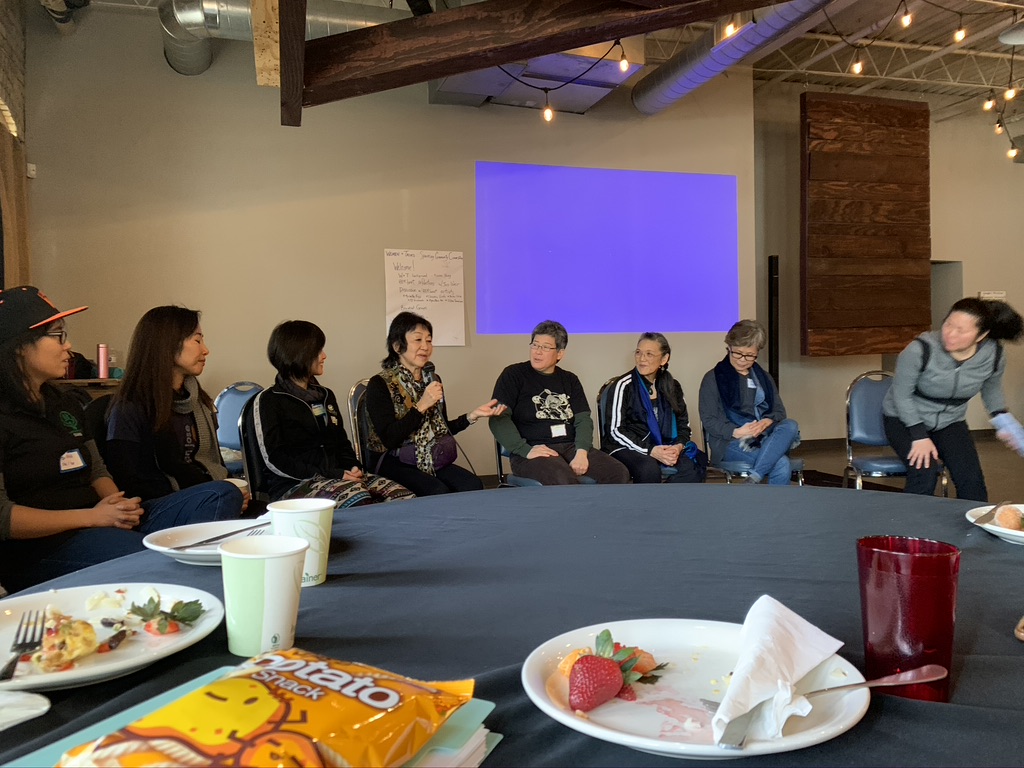
I noticed here that others knew much more about this practice than I did and that many of these people had already formed bonds at other taiko events that clued them in to certain procedures and processes. Needless to say it was here I felt the most awkward. I have been involved a sporadically in the taiko community. There is not much diversity in Iowa nor events for taiko people and everything was very far away. It was an extremely limited community and I wasn’t so involved that I would travel coast to coast to learn. However, the next part in this event was to find people we had not spoken to, sit down, and share our stories, which helped me bond with members and become establish myself in this community. I met someone who was a social justice activist interested in researching this event and a performer from the concert who hailed from California, aka the foremost place for taiko happenings. Making connections with them set me a little more at ease and here is when I started my practice of counting down from three, allowing me to get contact information from both of these people. Soon after we were encouraged to get breakfast and I used this time to ask Michelle, Karen, and Jennifer Weir for their contact info. Based on their body language I could tell that Karen and Jennifer were very much so willing, however Michelle seemed annoyed. I do not know if this was towards me, or as I later found out, a side effect of her unchecked injury from the concert the night before. Regardless, I felt proud that I checked that off my list of “contacts to get.”
We next sat and listened to some of the performers from the night before tell their stories. Some questions were about how they got asked to partake in the concert and other questions were more geared toward their taiko journeys. I was taking notes during this point, along with a few others, however, Michelle kindly asked us to put these away as the stories being shared were personal and they wanted to respect the privacy of those sharing. I put my notes away, understanding Michelle’s point and recognizing its importance that I had not thought of while writing, but continued to discover commonalities. Everyone who spoke was incredible honest, humble, and powerful. Some talked about growing too old for taiko while others shared how they felt being on the same stage as the pioneers for women and taiko professionals.

Sunday Ending Reflections
Other themes were collaboration, mindfulness, and community, each which the other performers echoed back as being important to their process and this project. The leaders of this event continually referenced this film, their website, and the events correlated to this event a movement, keying in on how women have been involved in taiko for years however equality is just now being discussed. This movement, as the recalled near the end of the meeting, is meant to bring women to the face of taiko, a place that has been dominated by men. To do so, Michelle and Karen wanted to establish mini-community groups where everyone could discuss what aspects of taiko life were important to them. Groups were formed around ideas that put taiko in conversation with parenting, LGBTQ+ inclusion, business, and activism. I went to the activism group in hopes to introduce myself to others who could help with my research. It was there we shared stories of how important this movement is and I met so many who were willing to help me with my project. I collected cards and emails/phone numbers of those who wanted to help and got to experience the input of others whose passion equaled or surpassed mine.
Overall it was an amazing experience which gave me so much to consider, question, and follow up with. I could not imagine a better weekend to begin being a “baby ethnographer,” to challenge myself in a week that was already challenging, and to inspire and motivate me to do it more. I hope you all get to experience similar times in your life that reinvigorate you and light you up! And with that, the longest possible blogpost I will ever do, is done!


