I was looking for inspiration for my blog post this week while listening to Volume II of Disney’s Sing-a-Long broadcast on ABC, when the song, “Part of Your World” came on with scenes from The Little Mermaid. I was promptly flooded with memories of a tumblr post claiming Ariel, sixteen-year-old and dad-defying mermaid, was indeed an anthropologist and thought, ‘This would be quite fun to dig in to for my blog post!’ For reference, below is a screenshot of said tumblr post that has popped up on various social media sites throughout the years:

Interesting theory, yeah? Not exactly a life-or-death research topic for the day, but fun to think about regardless! Now, my first step was to see if anyone else had anything to say on the topic. It was hard to find anything that wasn’t fan-fiction but I was able to find a review someone did for an Introduction to Anthropology course. Kea Lopez gives a quick glance at The Little Mermaid’s tie to anthropology, however, she focuses more on concepts in anthropology that are shown in the movie, rather than how Ariel herself is an anthropologist. Firstly, they separate two cultures set up in the movie: land and sea. In the movie, of course, Ariel belongs to the sea culture. Lopez digs in a little more by establishing cultural norms of the sea and of the land. They also dig into the misconstrued notions that the sea culture has of the materials and culture of humans. For example, the use of a dinglehopper (a.k.a. a fork). Now, the land people have no clue the sea culture exists, so misunderstandings don’t necessarily happen for them (more so the land culture doesn’t understand there is even a culture to be had underwater until Ariel drops in). Lopez’s review is helpful for laying out a base for this next part…
If we look at what Ariel does in the movie, we find a list of things that anthropologists may, also, do:
- Collect things from the culture/society and try to understand their function
- Longing to experience the society
- Getting emotionally involved (optional ;])
This semester, in both my Field Methods and Anthropology of Music courses, we dug into these “things anthropologists may do,” why we do or do not do them anymore and what has changed in the field. (Man it was really hard not to type do-do in that sentence) So let’s go step by step with what Ariel does that anthropologists also do!
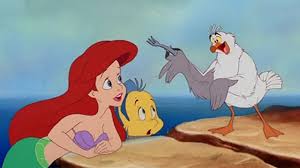
- Collect things from the culture/society and try to understand their function
Ariel has her treasure trove full of items she has collected from this culture that is vastly different from her own. She has wine stoppers, forks, statues, you name it. She is collecting these things and basically making a museum. Let’s stop and imagine what she is doing with these things. Ariel does try to figure out what these mysterious items are used for, so her collection of them are not just for show. She really is trying to figure out how their society functions through the objects she uses. However, banned from having contact with the humans to ask them herself, she is forced to seek the council of Scuttle, the ill-informed segal. Scuttle takes some creative liberties when describing objects to Ariel and leads her to believe that a dinglehopper is for brushing your hair, rather than eating food. This gets her in trouble later and could probably have been avoided if she wasn’t so confident in Scuttle’s assessments (she is only 16, I think she gets a pass). However, back to the main point, Ariel is trying to understand how human society operates, why the use certain things, and what their function is. These are all things anthropologists try to do (babies do this too but they aren’t exactly doing it to understand humanity…)
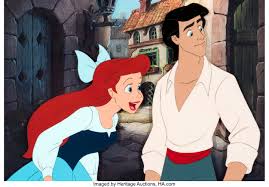
2. Longing to experience the society
Ariel really, REALLY wants to be where the people are, to see them dancing, watch them run, feel the sun, I could keep going but you are probably already singing the song so I’ll stop. In the iconic song, “Part of Your World” she specifically states she has questions and wants answers. She wants to experience how they live, interview them, and understand them better (granted she also makes assumptions about how they treat 16 year-old women on land, which Ursula explains even further, but this does not seem to deter her). In my studies this term, I was taught that witnessing a group firsthand, getting to ask questions, and seeing or doing things for myself is an important part of understanding other cultures. Participant observation is key to grasping concepts. Ariel wants to observe humans, understand fire and why it burns!
When she is finally on land, she has some advantages she needs already. She speaks their language (while more so she understands, since she can’t actually speak), she has an “understanding” of how parts of their culture work, and she has a familiar face, Eric, to help her navigate her studies! She is, however, not the most perfect anthropologist, like most of us. In the dinner scene she performs the classic blunder. She thinks she understands how to use the dinglehopper in front of her because she was confidently told its purpose by Scuttle and uses it to brush her hair only to find out that is definitely NOT how to use it. She then learns its actual purpose, to eat food. This is something some anthropologists will experience. Sometimes you just have to mess it up to really figure out what is happening or why! Here is another scene from the movie where she witnesses human culture in many other forms.

3. Getting emotionally involved
Lastly, Ariel has “gone native” in the movie. Granted, most anthropologists don’t start their work intending to become part of their informants world’s forever like Ariel does. Anthropologists do get emotionally involved in their studies and with those whom they study. We have to build rapport with our informants, if not to just be a kind person, but to understand with more clarity and continue a relationship. However, “going native,” meaning becoming completely a part of the society/culture the anthropologist studies is quite a stretch and can bring along bias and barriers that impact the goals of the anthropologist. While this doesn’t directly relate to Ariel’s being a “true” anthropologist, since defining what a true anthropologist is is impossible, it is important to note because it does impact her goals and relationships. She falls for Eric (swoon!) and this clouds her judgement when speaking to Ursula. She no longer wants to understand their culture, she wants to be with Eric. She ignores the hints Ursula drops about losing her freedom to speak, both literally and figuratively, in order to accomplish this. Not every going native experience is this extreme by the way, but its still an example of what I’ve learned about doing ethnography and/or anthropology.
So, it seems to me that Ariel is quite the potential anthropologist. If you, ya know, leave out the fact that: she is 16, is a cartoon, we have no other background information about her other activities or interests, that her interests in human culture gets totally derailed by a cute boy (relatable), and that its the mid-1800s in England during this movie, among other things. So, Pending the release of more information, I think Ariel is on her way to becoming a pretty good anthropologist! While she isn’t a full-fledged anthropologist, I don’t have enough information to make that claim, she definitely does things that anthropologists also do! THE END 🙂
I hope you enjoyed this post as much as I enjoyed writing it! See you all in class!